Guarana in Weight Loss Drops: Caffeine Content and Who Should Be Careful
Quick Answer: How Much Caffeine Does SodaBurn Actually Contain?
SodaBurn does not print a caffeine amount anywhere on its label. Its two caffeine-containing ingredients — Guarana (Paullinia cupana) Seed Extract and Green Tea Leaf Extract — are both named inside the 15.47 mg Proprietary Blend alongside 19 other ingredients, and only the blend's combined weight is disclosed. Guarana seeds are naturally caffeine-rich, and published research has measured meaningful caffeine content even in small guarana doses, but exactly how much caffeine ends up in one 1 ml SodaBurn serving cannot be calculated from the label as printed. The safest approach is to treat the caffeine content as genuinely unknown rather than assume it is negligible.
- On the label: guarana and green tea named, no caffeine milligram figure anywhere.
- In the research: guarana reliably contains caffeine; amounts vary by preparation.
- Who should be careful: caffeine-sensitive users, and anyone on diabetes, blood pressure or heart medication, per the label's own caution.
Two caffeine sources, one undisclosed total
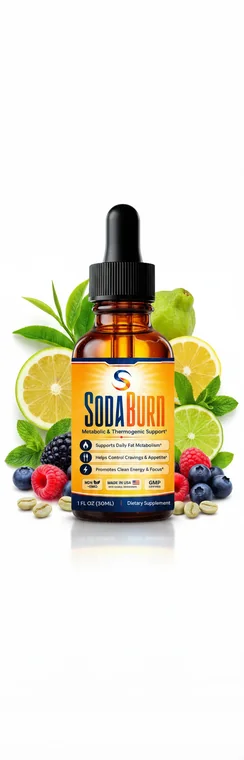
Look down SodaBurn's printed ingredient list and you will find Guarana (Paullinia cupana) Seed Extract in fourth position and Green Tea Leaf Extract in seventh, both inside the same 15.47 mg Proprietary Blend that holds 21 named ingredients in total. Both botanicals are well known for one thing above all else: they naturally contain caffeine. Guarana seeds are among the most caffeine-dense plant materials used in food and supplements, and green tea leaf is a familiar, moderate caffeine source used in everything from bottled tea to fat-burner capsules. Put them in the same formula and you have, by design, two caffeine sources working together — which is exactly the kind of detail a label is supposed to make clear to a buyer who is caffeine-sensitive or managing a health condition.
Except SodaBurn's label does not make it clear, because it cannot. The Proprietary Blend format discloses only the combined weight of all 21 ingredients (15.47 mg per 1 ml serving); it does not break out milligrams for guarana, for green tea, or for anything else in that blend, and there is no separate "caffeine (mg)" line anywhere on the Supplement Facts panel. That is worth stating plainly: the caffeine content of a SodaBurn serving is not a number you can look up. It is not printed, and it cannot be reverse-engineered from what is printed.
What guarana actually is, and what the research shows about its caffeine
Guarana comes from the seeds of Paullinia cupana, a climbing plant native to the Amazon basin, where its seeds have long been processed into a paste used as a stimulant and tonic. Unlike coffee or tea, guarana seeds pack caffeine at a notably high concentration by weight, alongside related methylxanthines like theobromine and a family of flavan-3-ol antioxidants (catechin and epicatechin among them). A 2024 chemical analysis of guarana seeds from Brazil's Bahia state, da Silva Junior et al., published in the International Journal of Food Science, measured caffeine, theobromine, catechin and epicatechin content across different seed-drying methods (sun-drying versus a traditional oven technique) and found that while UV exposure reduced flavan-3-ol content, the methylxanthine (caffeine-family) content did not differ significantly between drying methods. The practical takeaway is that guarana's caffeine content is a fairly robust, inherent property of the seed material itself, not something that disappears easily in processing — but the exact amount that ends up in any specific commercial extract still depends on how concentrated that extract is, which SodaBurn's label does not specify.
A more direct look at guarana's caffeine delivery comes from a 2024 randomized, double-blind, placebo-controlled crossover study in Nutrients, Talik et al., which compared a 500 mg guarana capsule against a 100 mg pure caffeine capsule and a placebo in twenty participants. The guarana capsule used in that trial was reported to contain about 130 mg of caffeine — meaning caffeine made up roughly a quarter of the guarana material's total weight in that specific preparation. Neither the guarana dose nor the low-dose caffeine produced consistent benefits on cognitive performance, heart-rate variability, or mood compared with placebo in that trial, which is a useful reminder that "contains caffeine" and "produces a noticeable effect" are not automatically the same thing at modest doses. But the caffeine content figure itself — roughly 26% of the guarana material by weight in that trial's preparation — illustrates how concentrated guarana extracts can be, and why an undisclosed amount inside a blend is not a detail to wave away.
What we know vs what SodaBurn's label discloses
| Question | Published research | SodaBurn label |
|---|---|---|
| Does guarana reliably contain caffeine? | Yes — consistently, across drying methods | Named as an ingredient; no caffeine figure given |
| How much caffeine can a guarana extract carry? | One tested 500 mg capsule contained ~130 mg caffeine | Not applicable — amount of guarana extract itself is undisclosed |
| Does green tea add more caffeine on top? | Yes, green tea leaf is a recognized caffeine source | Named separately in the blend; amount undisclosed |
| Total caffeine per SodaBurn serving | Cannot be estimated from public information | Not printed anywhere on the label |
Check the label before your first dose
If you are sensitive to caffeine, read SodaBurn's full ingredient panel and caution statement on the official page before ordering.
Order SodaBurnWhat the broader caffeine-safety research says
Because SodaBurn's own caffeine content is unknown, the most useful thing available is general research on caffeine safety from weight-management supplements and caffeinated products more broadly. A 2022 narrative review in Nutrients, Mah, Chen, Liska and Blumberg, examined the safety evidence for common weight-management ingredients including caffeine and green tea extract (EGCG). The review found that caffeine and green tea extract have recommended intake limits that are not typically exceeded when products are used as directed, and that serious adverse events are rare and generally involve unusually high intakes. It also noted the ordinary caveats that apply to any caffeine-containing supplement: possible gastrointestinal intolerance, and the potential for interactions with other medications or supplements a person is taking.
A 2021 Health Canada risk assessment focused specifically on cardiovascular effects, La Vieille et al., published in Applied Physiology, Nutrition, and Metabolism, reviewed caffeinated energy drinks and concluded that moderate consumption (up to 500 mL per day of a typical product) is not associated with increased cardiovascular risk for the general population of healthy adults. Critically, though, the same assessment explicitly reconfirmed that certain groups should not consume concentrated caffeine sources at all: children, pregnant or breastfeeding women, and caffeine-sensitive individuals. That is not a SodaBurn-specific finding — it is a general conclusion about caffeine exposure from any product that delivers it in meaningful amounts, which is directly relevant here precisely because SodaBurn's own caffeine amount is not disclosed and therefore cannot be assumed to be small.
The label's own caution, and the marketing claim that sits oddly next to it
SodaBurn's printed label carries a standard caution: do not exceed the recommended dose; not for use by individuals under 18, or by pregnant or nursing women; anyone with a known medical condition should consult a physician; keep out of reach of children. That caution is not caffeine-specific, but caffeine-sensitive individuals and anyone on diabetes, blood pressure or heart medication fall squarely within "known medical condition," and the caution to consult a physician applies to them directly given two caffeine-bearing ingredients sit inside the blend.
Separately, the seller's own marketing text states the product has "no harmful artificial stimulants," while the same materials acknowledge the formula's natural caffeine sources and advise caffeine-sensitive users, and people on diabetes, blood pressure or heart medication, to see a doctor. Both statements can be technically true at once — the caffeine present is plant-derived rather than a synthetic stimulant additive — but "not artificial" is not the same claim as "does not contain meaningful caffeine," and readers should not conflate the two. A natural caffeine source is still a caffeine source, and the label's own caution language reflects that even if the marketing phrasing could be read to suggest otherwise.
Three objections worth taking seriously
"It's only 15.47 mg total, so the caffeine must be tiny." That is a reasonable-sounding assumption, but it does not hold up under scrutiny. The Talik et al. 2024 trial found a 500 mg guarana capsule delivered roughly 130 mg of caffeine — about 26% of the material's weight. If SodaBurn's guarana extract were similarly concentrated, even a modest share of the 15.47 mg blend devoted to guarana could carry a non-trivial amount of caffeine relative to the whole serving. Without a disclosed amount, "tiny blend, so tiny caffeine" is an assumption, not a fact you can verify.
"Green tea's caffeine is basically decaf-level anyway." Green tea leaf extract is a moderate, not negligible, caffeine source, and it is commonly used in supplements specifically for its caffeine-plus-catechin combination. Pairing it with guarana, a much more concentrated caffeine source, does not cancel out either ingredient's contribution; it stacks two caffeine sources rather than one.
"If it were dangerous, it wouldn't be legal to sell." Legality is not the same as "safe for everyone at any dose." Caffeine from any source is broadly safe for most healthy adults at moderate intakes, which is exactly why the general research above frames the real caution around specific groups — caffeine-sensitive individuals, people managing diabetes, blood pressure or heart conditions, and those who are pregnant, nursing or under 18 — rather than around the ingredient category as a whole.
Who should be careful
Based on the label's own caution language and the general caffeine-safety research above, the people who should be most careful with SodaBurn, or pause to talk to a doctor first, include: anyone who already knows they are sensitive to caffeine (jitteriness, racing heart, or sleep disruption from normal caffeinated drinks); anyone managing diabetes, high blood pressure or a heart condition, or taking medication for any of those; anyone who is pregnant or nursing; anyone under 18; and anyone already consuming meaningful caffeine elsewhere in their day (coffee, tea, energy drinks, or other supplements), since an undisclosed additional caffeine source is harder to budget for against a personal daily limit. If you fall into any of these groups, the label's advice to consult a physician before use is the practical starting point, not an optional formality.
Medical note: this article is general information, not medical advice. SodaBurn's caffeine content per serving is not disclosed by the manufacturer. If you are pregnant, nursing, under 18, caffeine-sensitive, or managing a condition such as diabetes, high blood pressure or heart disease, or taking medication for any of those, speak with a healthcare professional before using this or any caffeine-containing supplement.
Frequently asked questions
How much caffeine is in SodaBurn?
SodaBurn's label does not print a caffeine amount. Guarana Seed Extract and Green Tea Leaf Extract, its two caffeine-containing ingredients, are both inside the 15.47 mg Proprietary Blend along with 19 other ingredients, and only the blend's combined total weight is disclosed, not milligrams of caffeine or the individual amount of either ingredient.
Is guarana just caffeine?
No, but caffeine is guarana's best-known active component. Guarana seeds naturally contain methylxanthines, caffeine chief among them, alongside catechins and other flavan-3-ols. A 2024 clinical study found a 500 mg guarana capsule contained about 130 mg of caffeine, but natural caffeine content varies by plant material and processing, so that ratio should not be assumed to apply to every guarana-containing product.
Who should be careful with guarana or caffeine-containing weight-loss drops?
Health-agency risk reviews advise that children, pregnant or nursing women, and caffeine-sensitive individuals avoid concentrated caffeine sources altogether. SodaBurn's own label separately cautions against use by anyone under 18 or pregnant or nursing, and advises anyone with a known medical condition, including those on diabetes, blood pressure or heart medication, to consult a physician first.
Does SodaBurn contain artificial stimulants?
The seller's marketing states there are "no harmful artificial stimulants," while the same materials acknowledge the formula's natural caffeine sources (guarana and green tea) and advise caution for caffeine-sensitive users. Both statements can be true at once: the caffeine present is naturally occurring rather than synthetic, but it is still caffeine, and the label does not disclose how much is in a serving.
Scientific references
- Talik TN, Penna EM, Hack BP, Harp A, Millard-Stafford M — Effects of Acute Guarana (Paullinia cupana) Ingestion on Mental Performance and Vagal Modulation Compared to a Low Dose of Caffeine, Nutrients (2024)
- da Silva Junior ALS, Nascimento MM, Santos HM, Lôbo IP, de Oliveira RA, de Jesus RM — Methylxanthine and Flavonoid Contents from Guarana Seeds (Paullinia cupana): Comparison of Different Drying Techniques and Effects of UV Radiation, International Journal of Food Science (2024)
- La Vieille S, Gillespie Z, Bonvalot Y, Benkhedda K, Grinberg N, Rotstein J, Barber J, Krahn AD — Caffeinated energy drinks in the Canadian context: health risk assessment with a focus on cardiovascular effects, Applied Physiology, Nutrition, and Metabolism (2021)
- Mah E, Chen O, Liska DJ, Blumberg JB — Dietary Supplements for Weight Management: A Narrative Review of Safety and Metabolic Health Benefits, Nutrients (2022)
Related reading
See the full ingredient panel
Read SodaBurn's complete label, including its caution statement, on the official product page before you order.
Order SodaBurn