Proprietary Blend Labels Explained: What SodaBurn's 15.47 mg Blend Does and Doesn't Tell You
Quick Answer: What Does "Proprietary Blend" Actually Mean?
A proprietary blend is a legal supplement-labeling format that discloses a group of ingredients' combined total weight, and their order by predominance, without requiring the individual amount of each one. SodaBurn's label shows exactly this: a Proprietary Blend of 15.47 mg per 1 ml serving containing 21 named ingredients in a fixed printed order, with "Daily Value not established." You can verify the total weight, the ingredient names, and their printed order. You cannot verify how many milligrams of any single one of those 21 ingredients you are actually getting — that number is not public information, and no amount of reading the label more closely will produce it.
- Disclosed: total blend weight (15.47 mg), ingredient names, printed order.
- Not disclosed: the individual milligram amount of any of the 21 ingredients.
- Legal status: permitted under U.S. supplement labeling rules; not unique to SodaBurn.

How a normal supplement facts line works
Before looking at a proprietary blend, it helps to see what a standard, fully disclosed ingredient looks like, because SodaBurn's own label has one right above its blend: Chromium (as Chromium Picolinate), listed at 7 mcg per serving, equal to 20% of the Daily Value. That is a complete disclosure. You know the exact form (chromium picolinate), the exact amount (7 mcg), and how that amount compares to an established government reference intake (20% DV). Nothing about that line requires guesswork. This is how the Supplement Facts panel is designed to work for any ingredient that has an established Daily Value and is not folded into a blend: name, form, amount, percent DV, printed in full.
Where a proprietary blend departs from that standard
Immediately below the chromium line, SodaBurn's label shows "Proprietary Blend — 15.47 mg — +" where the "+" footnote means "Daily Value (DV) not established." Underneath that single line, the label prints 21 ingredient names in a fixed order: Maca Root Extract, African Mango Seed Extract, Grape Seed Extract, Guarana Seed Extract, Eleuthero Root Extract, Astragalus Membranaceus Root Extract, Green Tea Leaf Extract, Gymnema Sylvestre Leaf Extract, Forskohlii Root Extract, Cayenne Pepper Fruit Extract, Grapefruit Seed, Ginseng Root Extract, Raspberry Ketones, L-glutamine, L-Tyrosine, L-Arginine, Beta Alanine, Monoammonium Glycyrrhizinate, GABA, L-Tryptophan and L-Carnitine HCl. That is the entire disclosure for all 21 of them: one shared weight, no individual breakdown. This is the defining feature of a proprietary blend, and it is legal under U.S. dietary supplement labeling rules, which permit manufacturers to disclose a blend's combined weight and ingredient order without itemizing individual amounts, in contrast to the itemized disclosure required for standalone ingredients like chromium.
Standard ingredient vs proprietary blend, side by side
| Chromium (standard line) | Proprietary Blend | |
|---|---|---|
| Ingredients covered | 1 | 21 |
| Individual amount shown | Yes — 7 mcg | No — only the 15.47 mg total |
| % Daily Value shown | Yes — 20% | Not established (blend has no DV) |
| What you can verify | Exact dose | Total weight, names, printed order only |
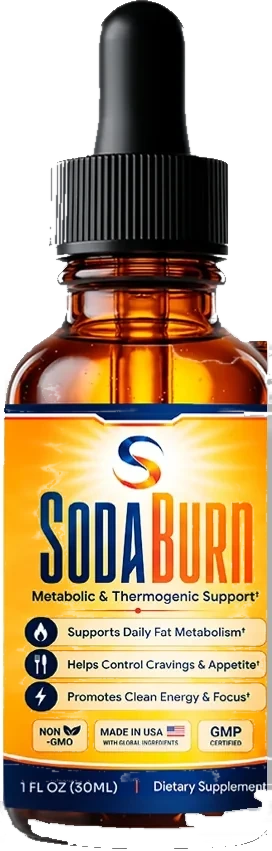
Read the actual panel yourself
See SodaBurn's full Supplement Facts label, exactly as printed, on the official product page.
Order SodaBurnWhat ingredient order actually tells you (and what it doesn't)
Ingredients inside a blend are generally required to be listed in descending order by weight, so SodaBurn's printed order — maca first, African mango second, grape seed third, and so on down to L-carnitine HCl last — is not random. It is a directional hint: earlier-listed ingredients are more likely to make up a larger share of the 15.47 mg than later-listed ones. But "more likely to be a larger share" is very different from "here is the milligram amount," and with 21 ingredients sharing 15.47 mg, the math limits what order can tell you. If the blend were divided even roughly evenly, each ingredient would average under 1 mg; if it is weighted heavily toward the first few names, as order suggests is plausible, the ingredients toward the end of the list could be present in genuinely trace, symbolic amounts. The label gives you no way to tell where any specific ingredient, including the ones you might care about most, actually falls on that spectrum.
A 2026 framework for thinking about this: "perception fillers"
This is not a problem unique to SodaBurn, and it has recently drawn direct academic attention. A 2026 Perspective article in the Journal of Nutrition, Alsawadi, proposes the term "perception filler" to describe situations where a declared ingredient, especially a raw botanical listed among active ingredients at a low, undisclosed quantity, may contribute more to how complete or strong a formula appears than to any interpretable nutritional or physiological effect. The article is explicit that existing label categories — active ingredients, excipients, proprietary blends — have no built-in mechanism for distinguishing an ingredient that is present at a functionally meaningful amount from one whose main role is to lengthen and strengthen the ingredient list on the front of the bottle. The paper does not name SodaBurn or any specific product; it describes a general labeling dynamic. But it is directly useful for reading any 21-ingredient, 15.47 mg blend: printed order and ingredient count tell you what is present, not how much of it, and not whether the amount present could plausibly do anything on its own.
Why this matters for judging the research behind any single ingredient
The practical consequence shows up the moment you try to connect a blend ingredient to its own clinical research. Take African mango: a 2013 systematic review of randomized controlled trials on Irvingia gabonensis, Onakpoya et al., covers studies that used around 300 mg per day of a standardized extract. SodaBurn's entire 21-ingredient blend totals 15.47 mg. Whatever fraction of that is African mango cannot be compared to the trial dose, because the fraction itself is not disclosed. The same structural problem applies to every one of the other 20 ingredients: guarana's caffeine content, grape seed's antioxidant dose, forskolin's studied amount, all sit behind the same undisclosed-fraction wall. Our companion piece on African mango in SodaBurn and our guide to guarana and caffeine content walk through two specific ingredients in more depth; this article is about the structural reason that gap exists for all 21 of them at once.
Case study: the "6 ingredients" claim versus the 21-ingredient label
Proprietary blend opacity does not just limit what a reader can verify; it also creates room for marketing text to drift from the label. SodaBurn's own seller website describes the product as a "6 natural ingredients" formula: chromium, African mango, green tea, guarana, maca and grape seed. The printed Supplement Facts panel tells a different story: 21 named ingredients inside the Proprietary Blend, plus chromium listed separately, 22 named items in total. Ginseng, eleuthero, astragalus, gymnema, forskolin, cayenne, grapefruit seed, raspberry ketones, a glycyrrhizin salt, GABA and five amino acids all appear on the label but not in the "6 ingredients" description.
This is a useful, concrete example of why the label, not the marketing copy, is the source to trust. The Supplement Facts panel is the legally controlling disclosure of composition; promotional text is written to be persuasive and simple, and is not held to the same standard. When the two disagree this substantially — 6 versus 21 named ingredients — the disagreement itself is informative: it tells you the marketing description was built for narrative simplicity, not as an accurate ingredient count, and it is a reason to default to the printed panel every time the two diverge on anything else, including implied roles, dosages or effects.
A general checklist for reading any proprietary blend
Applying the same logic to any supplement label, not just SodaBurn's, a few questions consistently separate what you can verify from what you cannot: Does the label give a total blend weight? (If yes, that total is real and verifiable.) Are ingredients listed in a specific order, and does the manufacturer claim that order reflects predominance? (Usually yes, and usually a legal requirement, but only a directional hint, not a number.) Is there a separate, non-blended ingredient elsewhere on the label with its own listed amount? (If so, compare how much more disclosure that ingredient gets, as with SodaBurn's chromium line, to calibrate how much the blend format is actually hiding.) Does the company's marketing copy describe the product differently than the label does — fewer ingredients, different emphasis, implied dosages? (If so, treat the label as controlling and the marketing text as promotional simplification.) None of these questions can produce an individual ingredient's milligram amount from a proprietary blend; that is precisely the disclosure a blend format is legally permitted to withhold. What they can do is tell you, honestly, what you actually know versus what you are assuming.
Three objections worth taking seriously
"Companies use proprietary blends to protect trade secrets, not to hide weak doses." That is a genuine, legitimate reason proprietary blends exist, and it is not this article's place to assume bad faith about SodaBurn's specific formulation reasoning. But trade-secret protection and undisclosed amounts are the same disclosure gap from a reader's perspective regardless of the manufacturer's motive: whichever the reason, you still cannot verify the dose.
"Surely they wouldn't include 21 ingredients if most were negligible." Ingredient count is not evidence of effective dosing. The 2026 "perception filler" framework exists specifically because listing many named ingredients can make a formula look more complete or potent than its total weight would support, independent of whether the manufacturer intends that impression.
"This is just how supplements work, so it doesn't matter." It is legal and common, which is different from saying it does not matter. It means direct dose comparisons to published clinical research, of the kind readers often want to make ingredient by ingredient, are simply not possible from the label alone. Knowing that is the whole point of learning to read one of these labels correctly.
Editorial note: this article explains how to read a proprietary-blend Supplement Facts panel in general, using SodaBurn's actual printed label as the worked example. It is not medical advice, and it does not estimate individual ingredient amounts that are not disclosed by the manufacturer. If you are pregnant, nursing, under 18, or managing a medical condition or medication, the label advises speaking with a physician before use.
Frequently asked questions
What is a proprietary blend on a supplement label?
A proprietary blend is a group of ingredients a manufacturer lists together under one name on the Supplement Facts panel, disclosing only their combined total weight rather than each ingredient's individual amount. SodaBurn's label shows one such blend: 15.47 mg total, containing 21 named ingredients in a fixed printed order, with Daily Value not established for the blend as a whole.
Is it legal to hide individual ingredient amounts in a proprietary blend?
Yes. U.S. dietary supplement labeling rules permit a proprietary blend to disclose only the blend's total weight and the ingredients in descending order by predominance, without requiring individual milligram amounts for each ingredient inside it. This differs from how single, non-blended ingredients like SodaBurn's chromium must be labeled, with an exact amount and percent Daily Value.
Does ingredient order tell you how much of each ingredient is present?
Order gives a rough directional hint, not a number. Ingredients in a proprietary blend are generally required to be listed in descending order by weight, so an ingredient named first likely makes up a larger share of the blend than one named last. But this cannot be converted into milligrams, and with 21 ingredients sharing 15.47 mg, even the ingredient listed first could still be a very small absolute amount.
Why does SodaBurn's own marketing describe fewer ingredients than the label?
The seller's marketing text describes SodaBurn as a 6-ingredient formula, while the printed Supplement Facts panel lists 21 named ingredients inside the Proprietary Blend plus chromium, 22 in total. Marketing copy is not held to the same disclosure standard as the label, and where the two disagree, the printed label is the legally controlling source.
Scientific references
- Alsawadi A — The Perception Filler: A Proposed Conceptual Framework for Ingredient-Interpretation Gaps in Food Supplements, The Journal of Nutrition (2026)
- Onakpoya I, Davies L, Posadzki P, Ernst E — The efficacy of Irvingia gabonensis supplementation in the management of overweight and obesity: a systematic review of randomized controlled trials, Journal of Dietary Supplements (2013)
- NIH Office of Dietary Supplements — Questions and Answers on Dietary Supplements
Related reading
Judge the label for yourself
SodaBurn's complete Supplement Facts panel, printed order and all, is on the official product page.
Order SodaBurn